
Product Knowledge
Training Module
Understanding Electrical Efficiency, Power Factor Correction, and Power Quality Improvement for AVDTECH Power Efficiency Enhancers.
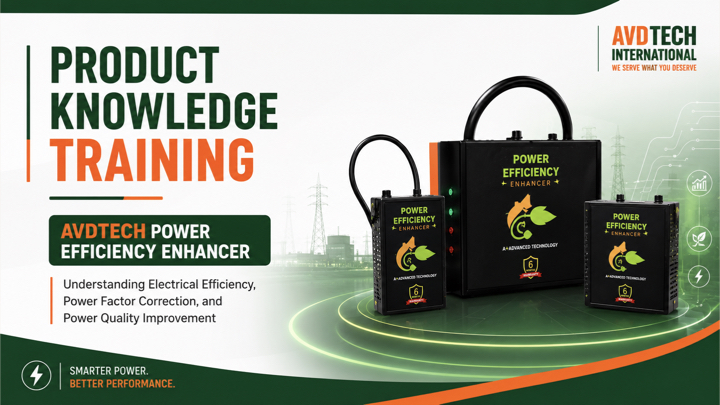
Slide 1 of 5
Understanding Electrical Efficiency
Official Presentation Slides
Interactive Slide Deck
Click on any module below to inspect the original training visual and technical breakdowns.
1. Overview & Training Intro
Understanding Electrical Efficiency, Power Factor Correction & Power Quality Improvement
Module 2 Breakdown
Training Objectives
After completing this training module, engineers, technicians, and customers gain complete mastery over the core power principles:
Compliant & Legal Product ClaimsWe emphasize 100% legal, accurate physics claims — ensuring customer expectations align with genuine electrical improvements.
What electricity is
Understanding AC power, voltage sine waves, and frequency stability.
What a bank capacitor is
How specialized dielectric capacitors store and release reactive charge.
What power factor means
The ratio of useful real power (kW) to total apparent power (kVA).
What power factor correction is
Reducing reactive current demand to lower line losses and heat.
How power efficiency enhancers work
EST technology balancing harmonic noise and stabilizing current flow.
Benefits of power quality improvement
Extended appliance lifespan, cooler operation, and lower utility penalties.
Proper and legal product claims
Verifiable science, compliance standards, and honest savings projections.
Module 3 Breakdown
Why Do We Need Electrical Efficiency?
Most homes and businesses suffer from hidden electrical inefficiencies that silently increase bills and degrade machinery.
Most Homes & Businesses Experience:
Voltage Fluctuations
Spikes and dips from grid instability that cause device resets.
Electrical Noise & Harmonics
Dirty electricity created by modern switching power supplies.
Reactive Power Losses
Wasted energy drawn by motors, AC units, and compressors.
Appliance & Component Stress
Excess heat causing premature failure of microchips and motors.
Poor Power Factor (<0.80)
Inability to convert drawn electrical current into productive work.
Reduced System Efficiency
Higher utility bills and wasted energy dissipated as heat.
These Conditions Directly Affect:
Equipment Performance
Runs cooler, operates at optimal RPM, and eliminates micro-stalls.
Electrical System Reliability
Prevents breaker trips, line overload, and phase imbalance.
Appliance Lifespan
Protects sensitive electronics from insulation breakdown and thermal decay.
⚡ AVDTECH Power Efficiency Enhancer directly addresses all 6 root causes through EST and magnetic capacitance filtering.
Module 4 Physics
Real Power (kW) vs. Reactive Power (kVAR)
Understanding the difference between productive electricity used by appliances and invisible magnetic circulation required by inductive loads.
Real Power (kW)
The actual power that performs useful work — running motors, lighting, air conditioning, and refrigeration. This is the power you actually turn into productive output.
Reactive Power (kVAR)
Power that circulates in the system but does not perform useful work. Required by inductive coils to sustain magnetic fields — it creates electrical demand without delivering physical output.
Module 6 Deep Dive
What Causes Poor Power Factor — And What It Costs
Inductive equipment continuously draws reactive power to sustain electromagnetic fields, creating severe system stress.
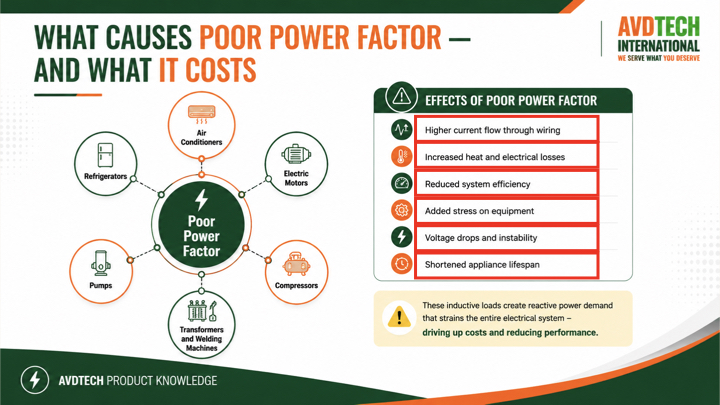
Primary Effects of Low Power Factor:
Higher Current Flow
Excessive amperage forced through wiring causes line resistance and thermal buildup.
Increased Heat & Electrical Losses
Energy wasted as heat in panelboards, breakers, and conduits.
Reduced System Efficiency
Lower overall capacity available for new machinery and appliances.
Added Stress on Equipment
Motors and compressors run hotter and degrade up to 40% faster.
Voltage Drops & Instability
Harmonic dips causing brownouts during high motor startup cycles.
Shortened Appliance Lifespan
Premature burnouts of expensive refrigeration and HVAC units.
Modules 7 & 8 Hardware
Capacitors: The Foundation
How energy storage components stabilize system voltage and supply reactive current on demand.
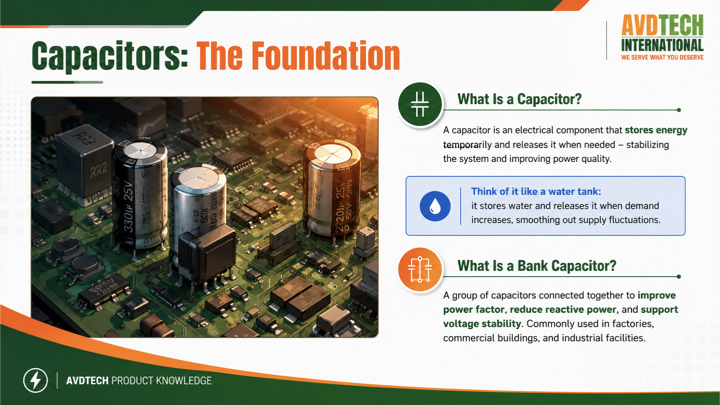
What is a Capacitor?
A capacitor stores energy temporarily and releases it instantly when demand increases — smoothing out voltage fluctuations.
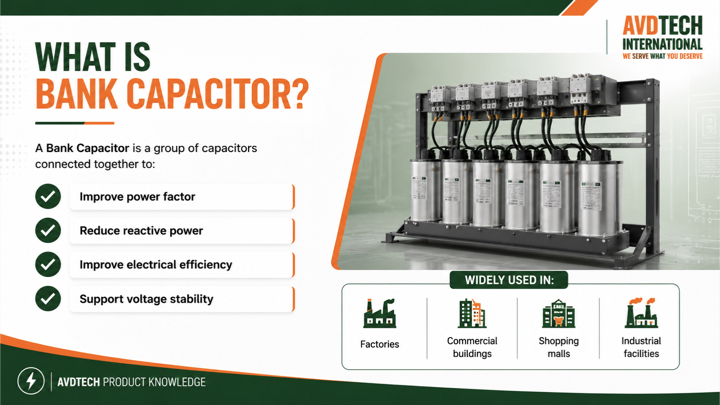
What is a Bank Capacitor?
A group of heavy-duty dielectric capacitors connected together to improve power factor, reduce reactive power, and support voltage stability across entire facilities.
Modules 9 & 10 Results
How Power Factor Correction Delivers Savings
Instead of pulling reactive power from the utility line, AVDTECH enhancers supply it locally at the load.
The 3-Step Correction Process
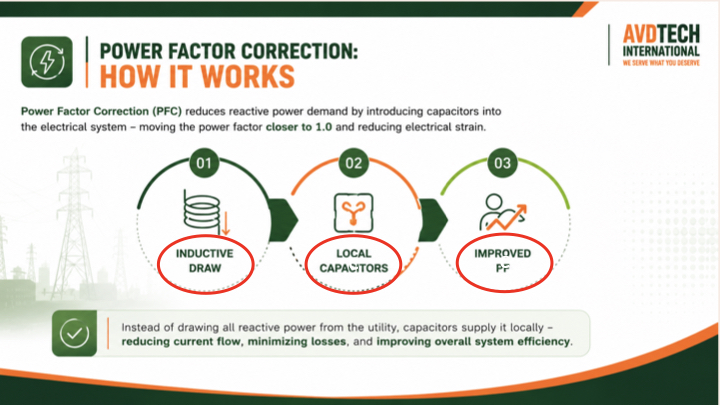
Step 01: Inductive Draw — Motors and compressors create a magnetic demand.
Step 02: Local Capacitors — AVDTECH unit instantly injects stored reactive power.
Step 03: Improved PF — Power factor moves close to 1.0, freeing grid current capacity.
Without Capacitors vs. With Capacitors
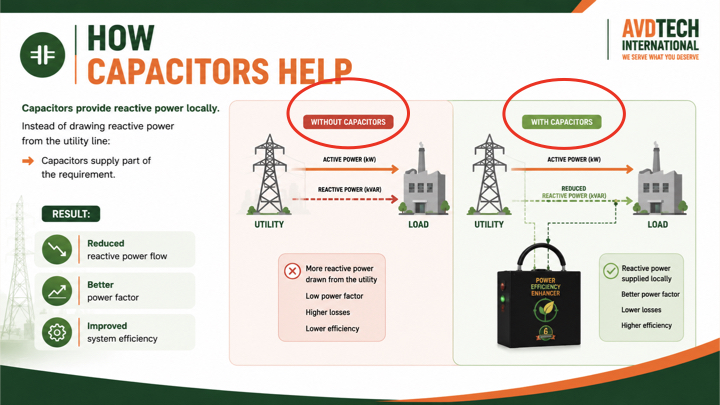
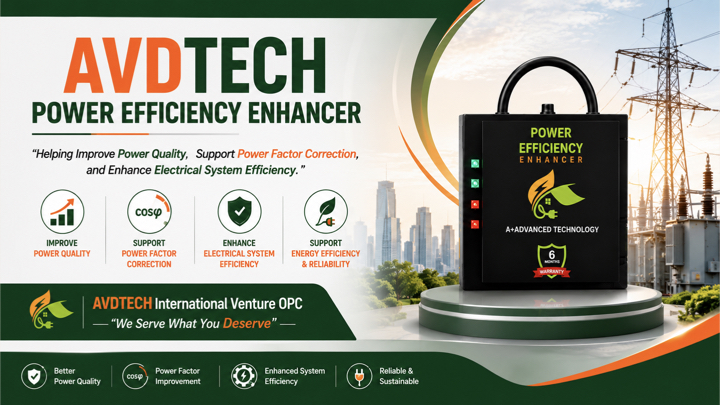
"We Serve What You Desire" — Helping Improve Power Quality, Support Power Factor Correction & Enhance Electrical System Efficiency.
Core Product Focus
What is AVDTECH Power Efficiency Enhancer?
A specialized capacitor-based power quality improvement device engineered for residential and small to medium commercial environments.
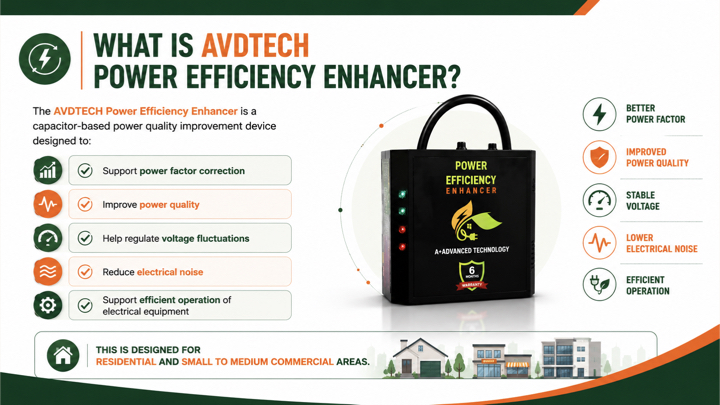
Engineered for 5 Key Objectives:
Support Power Factor Correction
Supplies local reactive power to reduce utility demand and improve power factor towards 1.0.
Improve Power Quality
Filters out high-frequency electrical harmonics and stabilizes power delivery.
Regulate Voltage Fluctuations
Mitigates sudden voltage spikes and line dips caused by heavy inductive load startups.
Reduce Electrical Noise
Suppresses carbon dirt electricity and electromagnetic interference (EMF/EMR).
Support Efficient Operation
Helps electrical equipment run cooler, smoother, and with lower thermal stress.
System Mechanics
How Does AVDTECH Work?
A 5-step automated workflow that continuously optimizes electricity delivery in real time.
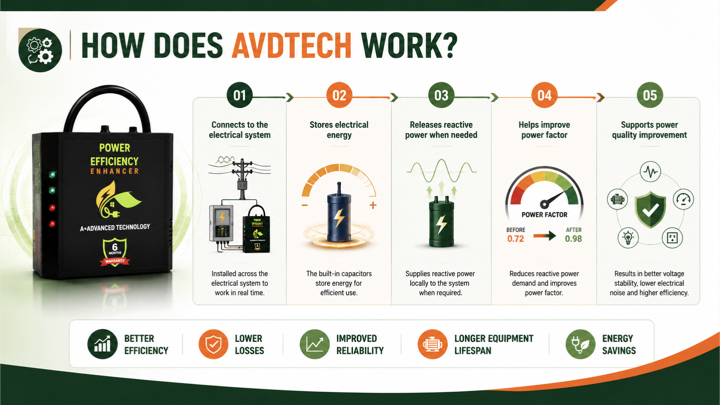
Connects to System
Installed across the electrical system to operate in real time at the main breaker or panel.
Stores Electrical Energy
Built-in heavy-duty capacitors store charge for immediate local release.
Releases Reactive Power
Supplies reactive power locally to motors and compressors as soon as demand arises.
Improves Power Factor
Reduces reactive power drawn from utility grid (e.g., boosting PF from 0.72 to 0.98).
Power Quality Results
Delivers voltage stability, lower electrical noise, and higher overall energy efficiency.
Target Environments
Common Applications & Industrial Guidelines
Optimized for homes, retail, and office environments — with specialized assessment protocols for industrial facilities.
Homes & Apartments
Protects household appliances from voltage transients while reducing reactive loss on heavy motor appliances:
Businesses & Retail
Stabilizes power lines across busy commercial facilities with multiple continuous inductive loads:
Factory & Industrial Power Factor Protocol
For industrial plants with existing capacitor banks, adding standalone enhancers is not recommended. For facilities without capacitor banks, we recommend a professional energy audit and power factor assessment to properly engineer and match the system load.
System Comparison
Why Power Quality Matters
Power quality directly affects the performance, efficiency, and operational lifespan of your electrical equipment.
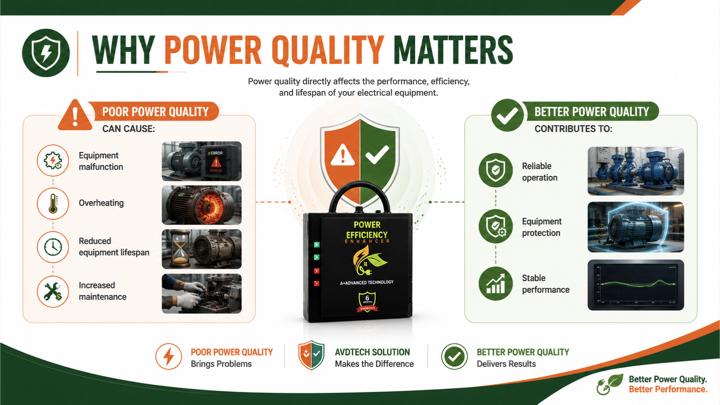
Poor Power Quality Causes:
- ❌ Equipment Malfunction
- ❌ Motor Overheating
- ❌ Reduced Lifespan
- ❌ Frequent Maintenance
Better Power Quality Delivers:
- ⚡ Reliable Operation
- 🛡️ Equipment Protection
- 📈 Stable Performance
- 💡 Lower Energy Waste
Module 5 Optimization
Understanding Power Factor
The Standard Formula
Power Factor = Real Power (kW) ÷ Apparent Power (kVA)
Measured from 0.00 to 1.00 — the closer to 1.0, the more efficient the overall electrical system.
Interactive Power Factor Simulator
Drag the slider to test power factor levels and view system efficiency ratings:
Severe energy waste, excess heat, and potential power company penalties.
Below 0.80
Poor
0.80 - 0.89
Fair
0.90 - 0.97
Very Good
0.98 - 1.00
Excellent
Get Started Today
Request Your Free Consultation
Fill out the form below and one of our industrial automation experts will reach out within 24 hours.
Disclaimer: This website is intended for product education and awareness purposes only. AVDTECH International makes no guarantees regarding specific energy savings, earnings, or results. Statements regarding reductions in electricity consumption are illustrative and may vary based on individual usage, environment, and installation. This is not a get-rich-quick scheme or a promise of fixed financial returns. All information shared through our Facebook Ads, Google Ads, and other marketing channels is provided for general informational purposes and should not be interpreted as professional advice. Always consult a qualified electrician or energy professional before installation.